In August 2018, code enforcement officers in Vero Beach cited a condominium on Ocean Drive after dozens of newly hatched sea turtles crawled toward the road instead of the ocean. At least four were killed by cars before anyone intervened. A second citation went to the owners of an oceanfront rental near the south end of the Conn Beach boardwalk. Both properties had lights visible from the beach during nesting season, which is exactly what Vero Beach's turtle lighting ordinance, on the books since 1990, exists to prevent.
That was one August. This one is shaping up to matter just as much, and most residents don't realize it, because the part of turtle season that gets promoted, the guided night walks where you watch a loggerhead dig a nest, wrapped up weeks ago.
Nesting Season and Hatching Season Are Different Seasons
Indian River County's sea turtle nesting season runs from March 1 through October 31. The public programming built around it, though, is a June-and-July phenomenon. Coastal Connections, the nonprofit headquartered in Vero Beach that runs the county's only dedicated sea turtle nonprofit program, held its Turtle Walks at Ocean Breeze Inn on Monday, Wednesday, and Saturday nights, and at Grand Harbor Beach Club on Fridays, all scheduled between June and July. Ask about a walk in August and the answer from county tourism staff has historically been some version of "not available, but we do free turtle digs, depending on the nests."
That gap isn't an oversight. It reflects the biology. A sea turtle egg takes roughly 65 days to incubate. A nest laid in early June hatches in early August. A nest laid at the height of July's egg-laying rush hatches deep into September. The walks stop because there's nothing left to walk toward. The nests, and the hatchlings emerging from them at night, are still very much on the beach.
What Last Year's Hatch Looked Like, and Why the Math Repeats
The mechanism runs the same way every season, but last year is the best documented example of what it can produce. Nesting activity in Indian River County peaked in July 2025, with 4,310 nests recorded that month alone, a 50 percent increase over July 2024. By September 12, 2025, the county had logged 11,295 nests across its 22.4 miles of coastline, a mix of 6,702 loggerhead, 4,515 green, and 78 leatherback nests. Quintin Bergman, the county's coastal resource manager, told local public radio station WQCS that the green turtle count alone had broken the species' prior record by roughly 400 nests before the season had even finished. Nearly 4,600 green sea turtle hatchlings emerged in 2025, topping the previous record of 4,100 set in 2023, itself more than double the 2,600 hatchlings recorded back in 2017.
That means the batch moving down the sand this same week last year was one of the largest the county has ever documented. This year's tally isn't public yet, but the underlying math doesn't change from one season to the next: whatever went into the sand in June and July is what comes out in August, whatever volume that turns out to be.
The county's year-over-year totals also swing enough that no single season predicts the next. It finished the 2022 season with 9,242 nests, then jumped to 12,771 in 2023, an increase large enough that officials called it a record year on its own. That kind of swing is exactly why the county counts nests one season at a time instead of assuming a pattern, and why nobody living near this beach should assume a given August is quiet just because no one has published a number yet.
The Rule Almost No One Reads Twice
Bergman put the actual rule in plain terms:
"The county has a nighttime lighting ordinance that requires any lights that can be seen from the beach to be either turned off at 9 p.m. or to be turtle-friendly, meaning it's an amber or red-colored light."
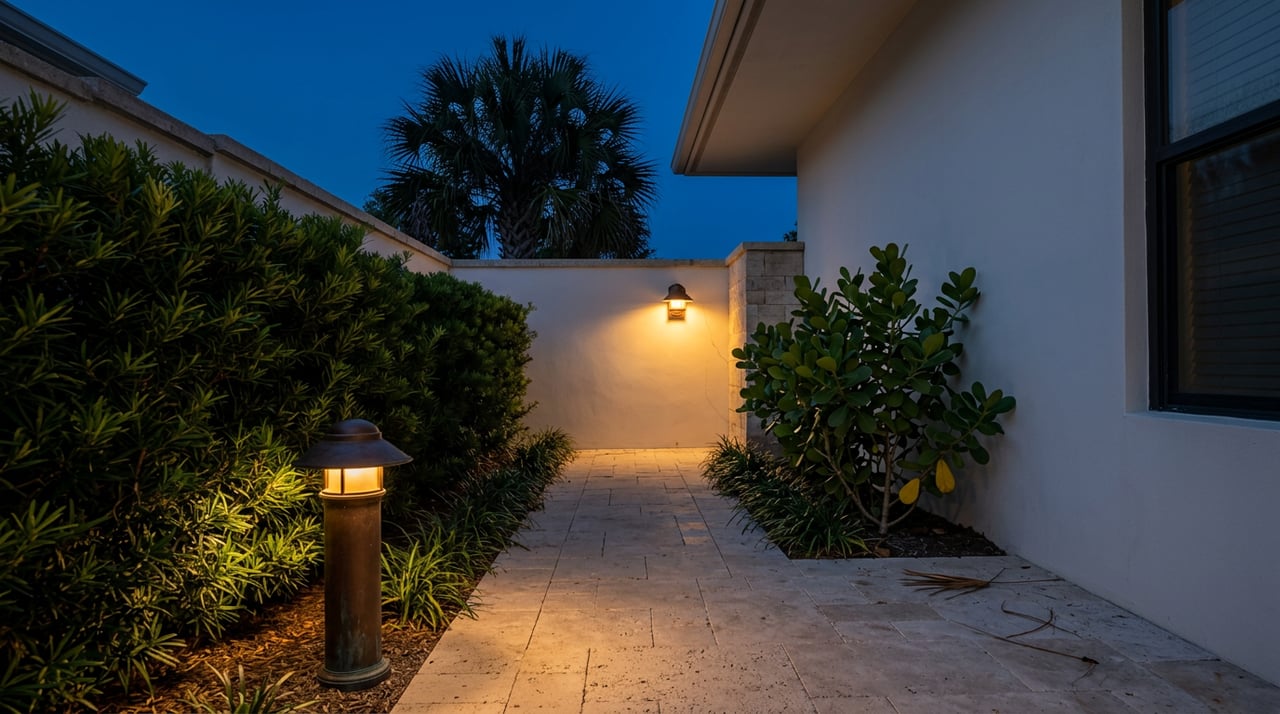
Indian River County, the City of Vero Beach, the Town of Indian River Shores, and the Town of Orchid each maintain their own version of this ordinance, so the exact wording depends on which side of a municipal line a property sits on. The underlying guidance is consistent across all of them:
- Use the lowest wattage possible, installed as low to the ground as possible.
- Use long-wavelength amber or red bulbs instead of white or blue light.
- Shield fixtures so they point downward and aren't visible from the sand.
- Close blinds and curtains facing the beach after dark.
- Turn off anything outdoors that doesn't need to be on.
A hatchling's entire navigation system is a preference for the brightest, lowest light on the horizon. On a natural beach, that's the moon reflecting off the water. On a lit beach, it can be a pool light, a porch fixture, or a lobby chandelier three properties back from the dune.
What Happens When a Property Doesn't Comply
The 2018 citations weren't an isolated enforcement action. Vero Beach's ordinance carries penalties of up to a $500 fine and 60 days in jail, and police in the city say they issue about a dozen "dark beach" citations in an average season. The ordinance itself, formally Municipal Ordinance No. 90-22, has been amended more than once since its original 1990 adoption, but the core obligation on property owners hasn't changed: if your light is visible from the sand between March and October, it's your responsibility, not the county's, to fix it.
That responsibility falls on more people than it might seem. Roughly 90 percent of the nests laid along this coastline are never marked with a stake or flag, according to the Sebastian Inlet District. Most sit unmarked and largely invisible, which means a lot of beachfront and near-beachfront homes are living directly next to a nest without any physical sign of it. The absence of a marker isn't the absence of a hatch date.
What You Can Still Do This Month
The Turtle Walks are done for the year, but the beach isn't done needing attention. A few things are still live in August:
Coastal Connections runs daily nesting surveys from May through August and feeds that data directly into the county's Habitat Conservation Plan, the coordination framework the county has maintained since 2005 to track nests across its full shoreline. If you see a scout with a clipboard at first light near Sexton Plaza Beach, that's the program at work.
If you come across a disoriented hatchling, a stranded adult, or anyone disturbing a nest, the number to call is the Florida Fish and Wildlife Conservation Commission's hotline at 1-888-404-3922. It's staffed for exactly this.
The county occasionally announces free public turtle digs in August, timed to when a nest is expected to hatch, though the notice is usually short. Watching the county's channels is the only reliable way to catch one.
And a few miles north, the same conservation instinct that protects this stretch of coast also protects Pelican Island, the nation's first wildlife refuge, tucked into the Indian River Lagoon near Sebastian. The dark, undeveloped beaches here exist for the same reason that refuge does: because something decided, a long time ago, that this particular coastline was worth leaving alone at night.
Bergman put it simply when WQCS asked him in 2025 what two decades of nest monitoring had accomplished: the county's program, by then in its 20th year, had been "a great benefit," even as he was quick to note the population is nowhere near stable enough to come off the federal endangered and threatened lists. The work isn't finished. It's just less visible in August than it was in July, which is exactly when it matters most.
If you live along this coastline, or you're the kind of person who ends up talking to a lot of people who do, Catherine Curley would love to compare notes over coffee, whether the subject is turtle season, the barrier island's next cultural event, or eventually, when the time is right, a move of your own. Request a private consultation whenever that day comes.